Prune Tall Trees Safely With a 27ft Manual Pole Saw
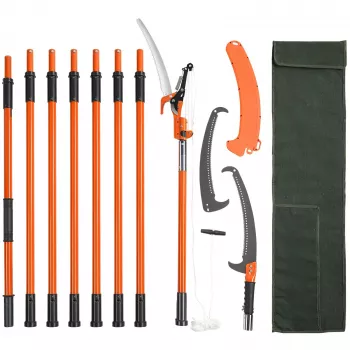
Tall-Tree Pruning Made Simple: Using a 27FT Extendable Manual Pole Saw
An extendable manual pole saw helps trim high limbs from the ground with more control and less setup than climbing. A long-reach tool also makes it easier to “prune a little, often”—removing deadwood and minor overgrowth before it becomes a bigger (and riskier) job. Below is a practical guide to when a 27-foot manual pole saw makes sense, what features matter most before buying, and how to use it safely for cleaner cuts on taller trees.
When a Long-Reach Manual Pole Saw Is the Right Tool
- Ideal for removing small-to-medium branches that are out of reach from the ground without bringing in powered equipment.
- Useful for routine canopy cleanup: deadwood removal, clearing branches from roofs, fences, driveways, and walkways.
- Often preferred in noise-sensitive areas and for quick touch-ups where setup time matters.
- Best results come from pruning within safe reach limits and avoiding heavy, overhead cuts that can swing or tear.
If you’re new to pruning, it helps to understand what “good cuts” look like and why timing matters. The International Society of Arboriculture’s public pruning resources are a solid reference for fundamentals like avoiding flush cuts and preventing unnecessary bark damage: Pruning Trees and Shrubs (ISA).
Key Features That Matter for a 27-foot Extendable Pole Saw
- Reach and adjustment: multiple sections or telescoping design lets you match the branch height without overextending.
- Blade design: sharp tooth geometry matched to green vs. dry wood, plus a stiff blade that tracks straight.
- Pole rigidity: less flex improves accuracy and reduces fatigue when fully extended.
- Grip and control: non-slip handle areas help you keep leverage during pull strokes.
- Connection points: secure locking mechanisms between sections reduce twisting under load.
- Carry and storage: segmented poles store more easily; confirm overall packed length so it fits your garage or shed.
As a rule, extend only to the shortest length that reaches the work. Every extra foot adds leverage against your arms and increases “whip,” which can turn a clean cut into a jagged one—or make the tool feel unpredictable.
Product Spotlight: 27FT Extendable Manual Pole Saw
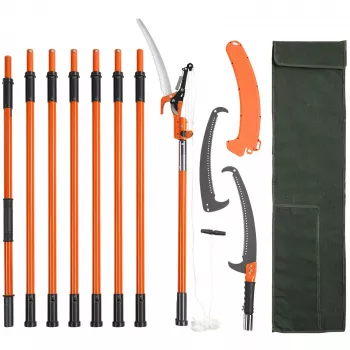
The 27FT Extendable Manual Pole Saw is built for high-branch trimming from the ground using a manual cutting action. It’s a practical option for homeowners and light property-maintenance tasks where height capability matters, but you’d rather skip the upkeep of a motor, battery, or fuel. For best performance, confirm the intended branch-size range and plan on slow, controlled strokes—manual pole saws reward patience with straighter tracking and cleaner finishes.
Before ordering, check current pricing and the latest product images on the listing page to verify what’s included and how the sections lock together.
Quick Specs and Buying Checklist
| Item | What to check | Notes for this product |
|---|---|---|
| Maximum reach | Total extension length and usable cutting height | Listed as 27FT extendable |
| Cutting setup | Manual pull-saw action, blade type, replacement availability | Manual pole saw design; verify blade details on the product page |
| Stability at full extension | Pole stiffness, lock security, section fit | Prioritize tight locks to reduce wobble |
| User comfort | Handle grip, weight distribution, section length options | Long tools are easier when adjusted to the shortest effective length |
| Safety compatibility | Ability to work from the ground, clearance around hazards | Maintain safe distances from power lines and falling zones |
Related, in-stock add-on
After pruning, sap and debris often end up on gloves and work clothes. For a simple, low-waste routine that helps keep cleanup consistent, see: Eco-Friendly Laundry Day Checklist | Sustainable Living Guide (Digital Download).
Safe Setup Before the First Cut
- Survey the drop zone: clear people, pets, vehicles, and breakables from the area below.
- Plan the cut and the fall path: branches can swing, bounce, or roll after landing.
- Check overhead hazards: keep well away from power lines and service drops; if a limb is near lines, use a qualified professional.
- Wear protective gear: safety glasses or face shield, gloves, and sturdy footwear; a hard hat is recommended for overhead cutting.
- Use the shortest effective length: extend only as much as needed to reduce flex and improve accuracy.
- Avoid unstable footing: do not stand on loose gravel, wet slopes, or improvised platforms.
Professional safety guidance is worth reviewing even for “simple” yard work. For additional safety context, see Tree Work Safety (OSHA) and Working Safely Near Overhead Power Lines (NIOSH).
Cutting Technique for Cleaner Pruning
Care, Storage, and Blade Maintenance
FAQ
How thick of a branch can a manual pole saw cut effectively?
Most manual pole saws perform best on small-to-medium limbs, especially in green wood where a sharp blade bites cleanly. As branch thickness increases, the cut takes longer and becomes harder to control overhead, so it’s safer to remove weight in stages or call a professional for large limbs.
Is it safe to use a 27-foot pole saw near power lines?
No—working near power lines is hazardous, and long tools increase the risk. Maintain generous clearance; if any branch is close to energized lines or service drops, contact the utility or a qualified arborist instead of attempting the cut.
Why does a pole saw feel shaky when fully extended?
A fully extended pole creates more leverage and magnifies normal flex, which feels like wobble at the blade. Use the shortest effective length, confirm all locks are tight, keep a stable stance, and choose manageable branch sizes to reduce twisting and whip.













Leave a comment