AI Mecanum Robot Car with Robotic Arm for Learning
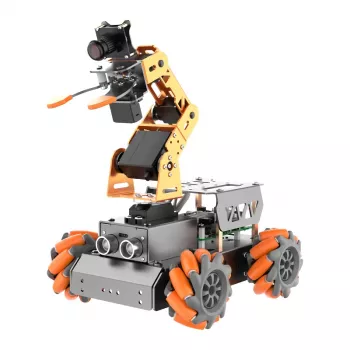
AI-Enhanced Smart Robot Car with Mecanum Wheels and Robotic Arm
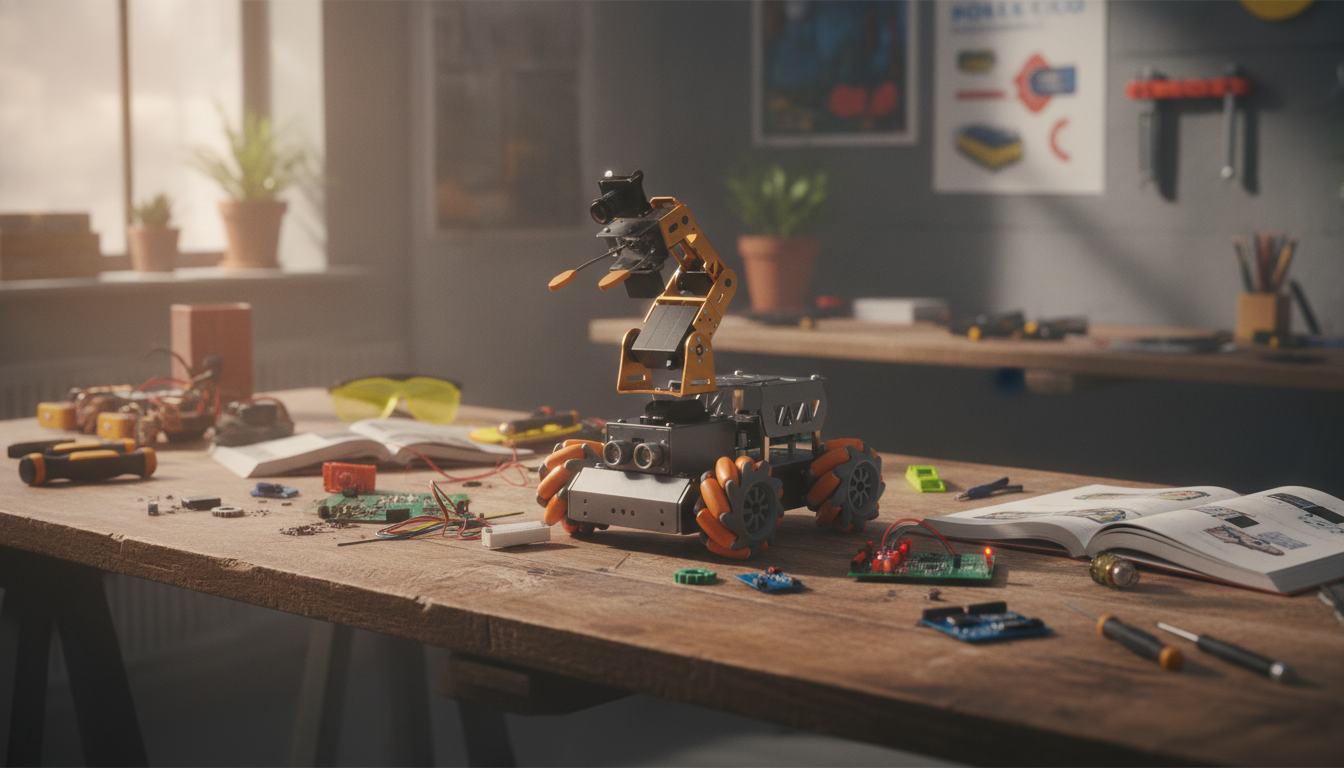
A compact mobile manipulator that combines omnidirectional mecanum-wheel driving with a multi-joint robotic arm, designed for hands-on learning, prototyping, and small-scale automation experiments. This setup supports precise lateral movement, tight turning, and basic pick-and-place style tasks—useful for classrooms, labs, and makers building AI- and vision-guided behaviors.
What Makes This Robot Car Different
The main advantage of a mecanum-based robot car is freedom of movement. Instead of committing to wide turns, the base can translate sideways, diagonally, or rotate in place—often without changing the arm’s orientation to the workspace. Add a robotic arm on top, and the platform becomes more than a vehicle: it becomes a learning-friendly “mobile manipulator” for interacting with objects.
- Omnidirectional mecanum wheels enable forward, backward, sideways, diagonal motion, and rotation without repositioning.
- Robotic arm adds interaction with objects, not just navigation—ideal for grasping, sorting, and simple manipulation demos.
- AI-enhanced workflows support experimentation with autonomy concepts like perception-to-action loops (camera/sensor input driving motion decisions).
- Modular form factor suits iterative upgrades: sensors, camera mounts, grippers, and software stacks can be expanded over time.
- Useful across skill levels: beginners can start with teleoperation; advanced users can implement mapping, tracking, or task scripts.
Core Capabilities for Movement and Handling
For indoor robotics, small geometry changes matter. Being able to strafe a few inches can turn a “missed grasp” into a clean pickup, and rotating in place can help a camera scan a shelf or a marker without drifting away. When the base and arm are coordinated as a single system, approaches become smoother: approach, align, reach, lift, and retreat can be practiced and improved with repeatable tests.
- Omnidirectional drive: strafe along a shelf or lab bench while keeping the arm facing the work area.
- Fine positioning: use small corrective lateral moves to line up a grasp without complex turning maneuvers.
- Arm coordination: combine base motion and arm motion for smoother approaches to targets (approach → align → reach → lift).
- Repeatable practice: run the same route and pick sequence multiple times to validate tuning changes.
- Controlled rotation: rotate in place to scan an area or track a target while maintaining position.
Example Tasks and the Features They Rely On
| Task | Why Mecanum Helps | Why the Arm Helps | Typical Learning Outcome |
|---|---|---|---|
| Pick an object from a marked spot | Strafe to align precisely without turning | Reach, grasp, and lift | Coordinate perception, alignment, and actuation |
| Follow a line and place an item at a drop zone | Smooth path corrections, tight turns | Release at a target location | Closed-loop control and basic automation logic |
| Desk-side delivery demo (small payload) | Navigate around obstacles in tight space | Place item onto a platform | Planning and safe approach behavior |
| Station-to-station sorting | Quick lateral repositioning between bins | Pick-and-place repetition | Repeatability, timing, and motion tuning |
Where It Fits Best: Education, R&D, and Prototyping
This style of robot is a practical bridge between theory and real-world behavior. It’s small enough to run on a bench-top course or classroom floor, yet rich enough to demonstrate how sensors, software decisions, and mechanical limits interact. For deeper software exploration, many builders use common robotics patterns such as modular “nodes” for perception and control; if you want a widely used reference point, the ROS documentation provides a helpful foundation for concepts and tooling.
- STEM learning: demonstrates kinematics, control, and manipulation in one platform.
- Computer vision practice: experiment with object detection, color tracking, or fiducial markers to guide navigation and grasping.
- Robotics software fundamentals: learn topics like coordinate frames, inverse kinematics concepts, and sensor fusion at a manageable scale.
- Automation proof-of-concept: test small workflows such as moving items between stations, scanning labels, or interacting with buttons/levers (with proper safeguards).
- Team projects: good for dividing work—one person handles base control, another handles arm/gripper logic, another handles perception.
For inspiration and real engineering context, browsing IEEE Spectrum Robotics and NASA Robotics can help connect classroom experiments to how robots are evaluated for reliability, safety, and mission goals.
Setup Expectations and Practical Considerations
Mecanum drive rewards a clean environment and a calibration mindset. Smooth floors and consistent traction make lateral motion feel “locked in,” while carpets, cords, thresholds, and uneven tiles can introduce drift. The robotic arm adds another layer: a small change in base position can significantly affect end-effector alignment, so slower test speeds and structured experiments typically produce faster progress.
Software and AI Project Ideas (Beginner to Advanced)
Care, Maintenance, and Reliability Tips
In-Stock Picks
- AI-Enhanced Smart Robot Car with Mecanum Wheels and Robotic Arm
- Propane Tankless Water Heater, 7.4 GPM, Indoor Use, Instant Hot Water
- Elegant Korean Style Bow Pockets Short Coat for Women
FAQ
What are mecanum wheels good for on a robot car?
Mecanum wheels enable omnidirectional motion—strafe, diagonal travel, and rotation in place—which is especially useful in tight indoor spaces where turning radius is limited. The tradeoffs are that performance depends on smooth surfaces and careful calibration to reduce drift.
Can the robotic arm pick up real objects reliably?
Yes, within realistic limits: it’s best suited to lightweight items, and reliability depends on gripper design, object shape, friction, and consistent alignment. Early success improves a lot when objects are placed in repeatable spots or assisted by simple markers or guides.
Is it suitable for learning AI and robotics software?
It’s a strong platform for practicing vision-guided behaviors, control loops, and structured task logic because you can see decisions translate into base motion and grasp attempts. Start with teleoperation, then add perception and autonomy gradually with safety limits like low speeds and an emergency stop.














Leave a comment