How Gucci Becomes a Trend Machine (eBook Guide)

Gucci & the Trend Machine: Why One Luxury House Can Keep Rewriting What Feels “Current”
Gucci’s influence extends beyond runway moments into the systems that turn aesthetics into widespread behavior—imagery, collaborations, cultural signals, and the pace of digital media. When a single brand repeatedly becomes a reference point for what people wear, save, and copy, it’s rarely accidental. It’s a machine: a repeatable way of packaging creativity into recognizable cues that travel fast, look good on camera, and feel easy to adopt. For more guidance, see How Gucci Uses Big Data to Enhance Digital Marketing.
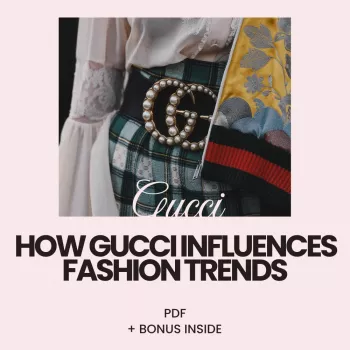
Gucci & the Trend Machine: How a Brand Shapes Fashion Futures – eBook digital download breaks down how that machine works—linking creative direction to trend forecasting and brand strategy in a clear, usable framework for students, creatives, marketers, and fashion-curious readers. For further reading, see [PDF] A Comparative Analysis of Gucci and Zara.
What “the trend machine” means in luxury fashion
A trend machine is the repeatable system that converts creative direction into signals that travel: runway themes, campaign imagery, styling cues, retail storytelling, and celebrity placement. Luxury brands can lead trends by shaping taste, not merely reacting to it—using heritage codes (logos, motifs, silhouettes) as recognizable anchors that audiences can identify instantly.
The “Gucci effect” often comes from making contrasts feel wearable: classic plus eccentric, high craft plus internet-native references. Over time, influence becomes measurable through adoption—red-carpet echoes, fast-fashion knock-ons, moodboard duplication, and even shifts in consumer vocabulary (what people start calling “in”).
How Gucci turns creative direction into culture
For a look to become a trend, it needs to be both distinctive and repeatable. Gucci’s signature codes help accomplish that: horsebit hardware, GG monogram, bamboo handles, bold color stories, and maximal styling cues that are easy to spot in a scroll.
1) Brand codes that “read” at a glance
Strong codes create visual shorthand. A single detail—hardware on a loafer, a monogram placement, a saturated color pairing—can become a template others imitate without needing the full runway context.
2) Campaign imagery as portable narrative
Campaigns and visuals function like mini-worlds: they communicate mood, identity, and aspiration in seconds. Once those narratives hit social platforms, press, and retail touchpoints, they become a shared reference that stylists, creators, and shoppers can remix.
3) Collaborations that compress time-to-impact
Collaborations and capsules borrow existing audiences and place Gucci aesthetics in new contexts. That cross-pollination speeds up recognition and makes the brand feel present in multiple cultural conversations at once.
4) Celebrity dressing that validates the look
Celebrity placements and influencer seeding can turn a look from “editorial” into “must-have.” When multiple high-visibility people converge on similar silhouettes or accessories, the trend reads as socially confirmed rather than experimental.
5) Retail as world-building
Store design, merchandising, and packaging reinforce the idea that Gucci is a cultural world, not just a product line. That “world” gives consumers language and imagery to share—making the brand’s signals even easier to spread.
Trend forecasting lessons pulled from Gucci’s playbook
Gucci makes a strong case study because it shows how a brand can refresh its identity without losing recognizability. For forecasting, a few lessons stand out:
Where the influence shows up first: fast indicators to monitor
Trend signals and what they usually predict
| Signal type | Where it appears | What it can indicate | Typical timing |
|---|---|---|---|
| Accessories spotlight | Runway close-ups, street style, product drops | Which codes will become widely recognizable | Weeks to 3 months |
| Campaign aesthetic shift | Lookbooks, film campaigns, major visuals | New narrative direction and mood for the season | 1 to 6 months |
| Celebrity clustering | Multiple high-visibility placements | Trend validation and mainstream readiness | Days to 2 months |
| Editorial styling echoes | Magazines, stylists, fashion week coverage | How the look will be translated for everyday wear | 1 to 4 months |
| Resale/vintage spike | Secondhand platforms and archival chatter | Revival of past-era silhouettes or logos | 3 to 12 months |
Inside the eBook: what the guide helps readers do
Who it’s for and how to use it
Digital download details
Recommended digital downloads
- Gucci & the Trend Machine: How a Brand Shapes Fashion Futures – eBook Guide on how gucci influences fashion trends, Luxury Branding & Trend Forecasting Digital Download
- The Ultimate Business Growth Hack Checklist: Scale Smarter, Not Harder | Digital Download for Entrepreneurs & Small Business Owners | Business Growth Hacks
- Your Bright Mindset Boost Checklist: 3 Simple Steps to Think Positive Every Day
Further reading (authoritative sources)
FAQ
How does Gucci influence fashion trends so quickly?
Gucci’s speed comes from a compounding loop: recognizable brand codes appear on the runway, get amplified through campaigns and celebrity visibility, then are rapidly reinterpreted on social platforms. That repetition across multiple channels makes the aesthetic feel confirmed and easy for wider audiences to adopt.
Is the guide more about fashion history or forecasting?
It uses Gucci as a case study to connect heritage codes to modern forecasting methods, balancing cultural context with practical tools. The focus is on how trend signals move and how to interpret them, rather than providing a purely historical timeline.
Who benefits most from this eBook?
Fashion students and researchers get a clear structure for analyzing influence; marketers and brand builders learn how identity becomes shareable signals; creators and stylists gain a way to anticipate what will read as “current.” Collectors and enthusiasts also benefit from understanding why certain motifs cycle back and how nostalgia turns into a future-facing trend.










Leave a comment