Hermès Brand Identity, Explained with AI Pattern Analysis

Decoding Hermès Through AI: A Clear Guide to the Brand’s Identity
Hermès is often described as timeless, discreet, and uncompromising—but those labels can feel vague until the details are broken down. This guide frames Hermès through an AI-assisted lens: patterns in materials, silhouettes, color, iconography, language, and retail rituals that repeatedly signal the house’s identity. The goal is to make the brand’s codes legible, whether for collectors, students of design, or anyone curious about how luxury meaning is built and protected. For more guidance, see (PDF) Analysis of the Exclusivity of Hermès Handbags – ResearchGate.
What “brand identity” looks like at Hermès
At Hermès, identity functions less like a logo and more like a system: product design, craftsmanship standards, pricing discipline, scarcity, and controlled distribution all reinforce one another. Many of the strongest cues are not loud. They’re tactile (leather handfeel, edge paint cleanliness, stitching rhythm) or contextual (how items are presented, repaired, and sold). For further reading, see [PDF] Analysis of the Advantages and Disadvantages of Luxury Brands ….
Seasonal variation exists, but the core codes remain stable across decades. That consistency is the point: novelty is allowed, but it must fit within a long-established framework. AI can help by surfacing recurring features across images, text, and product attributes—turning “taste” into observable patterns that can be compared across time.
The house’s origins and the logic of equestrian heritage
Hermès began with an equestrian foundation, and that origin still shows up as a design logic. Hardware and leatherwork often feel engineered rather than purely decorative—buckles, straps, and closures read like functional mechanisms with a job to do. This influences the “why” behind many forms: pieces are built to carry, secure, protect, and endure.
Practicality is part of the luxury claim. Durability, repairability, and long product lifecycles become status signals because they require discipline: better materials, tighter construction tolerances, and a willingness to prioritize longevity over quick trend impact. Many motifs trace back to riding culture and travel—harness details, saddle-inspired forms, and carriage imagery that remain legible even when modernized.
Heritage also acts as a design constraint. When new designs still feel compatible with older ones, continuity becomes a lived experience rather than a marketing line. For background context, see the Encyclopaedia Britannica overview of Hermès and the brand’s own perspective at Hermès (official site).
Craftsmanship as a visible language, not a slogan
Hermès craftsmanship communicates through construction choices: leather selection, hand-stitch associations, edge finishing, and hardware weight. Even without deep technical knowledge, the message is readable—especially when compared side-by-side with less disciplined production.
Quality control acts as identity protection. Small tolerances, consistent proportions, careful material matching, and clean alignment keep the product “quiet” in the way Hermès prefers: confidence without clutter. The repair ecosystem reinforces that posture. Maintenance and refurbishment position the customer as a steward of an object rather than a consumer of something disposable.
AI-assisted analysis can contribute here by comparing macro-features (shape, panel geometry, hardware placement) and micro-features (stitch density, edge-color uniformity) across reference sets. It doesn’t replace expertise, but it can make recurring signals easier to spot at scale.
Design codes that repeat across categories
Across leather goods, ready-to-wear, and silk, a few repeated choices do much of the identity work: silhouette restraint, purposeful closures, and material storytelling. Lines tend to be clean, proportions balanced, and ornamentation controlled. Hardware is often understated but highly intentional—structured forms that read as tools rather than jewelry.
Hermès identity codes and how they tend to show up
| Identity code | What it signals | Where it often appears | What AI can flag consistently |
|---|---|---|---|
| Equestrian references | Heritage, utility, engineering mindset | Hardware, straps, buckles, motifs | Repeated shapes (buckles/loops), carriage-like iconography |
| Structured minimalism | Timelessness, restraint, confidence | Bags, coats, small leather goods | Stable silhouettes, low visual noise, high symmetry |
| Material precision | Craft authority, longevity | Leather grain, edge paint, stitching | Texture patterns, stitch regularity, edge-color consistency |
| Color discipline | Recognizable palette and controlled boldness | Silk, leather, seasonal accents | Palette clustering, recurring high-contrast pairings |
| Ritualized retail experience | Exclusivity, trust, relationship-led access | Packaging, service, appointment culture | Language patterns in product copy and reviews; packaging cues in imagery |
Color, typography, and iconography: the “quiet loud” signals
How AI helps decode a luxury house without flattening it
Reading Hermès like a system: product, service, scarcity, and trust
Getting value from the guide
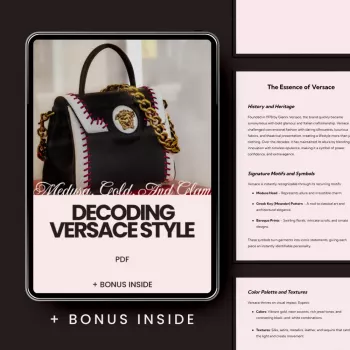
For deeper study in a single resource, consider the digital guide Decoding Hermès Through AI: Exclusive Guide to Understanding the Luxury Brand’s Identity. To train the eye on structure and proportion in everyday styling, a piece like the Elegant Korean Style Bow Pockets Short Coat for Women can help highlight how clean lines and controlled detailing create a polished silhouette.
FAQ
What does “decoding Hermès through AI” mean in practice?
It means using AI to spot repeated visual and language patterns across many references—silhouettes, motifs, palettes, and recurring wording—so the brand’s codes become easier to organize and compare. It supports interpretation, but it doesn’t replace historical knowledge or cultural context.
Is Hermès identity mainly about the logo and orange box?
No. Those are strong recognition cues, but the identity is more consistently carried by craft standards, material choices, proportions, hardware logic, and long-term service rituals.
How can beginners learn to spot Hermès design codes without buying anything?
Study official product photography, runway archives, and museum or exhibition references while focusing on structure, hardware placement, stitching and edge finishing, motif families, and restrained styling. Close-up comparisons across seasons make the recurring rules easier to see.













Leave a comment