Start an Online Business With No Money (Free Tools + AI)

How to Start an Online Business with No Money Using Free Tools and AI
Starting from zero budget is possible by choosing a simple model, validating demand quickly, and using free platforms to create, market, and deliver an offer. The fastest path is building momentum with minimal risk: pick one problem to solve, set up a lightweight online presence, create a first offer, and get the first customers through consistent outreach and useful content—while using AI to move faster and communicate more clearly.
Step 1: Pick a simple business model that works without upfront costs
When money is tight, the goal is to avoid anything that forces you to pay before you learn what customers actually want. Start with what can be delivered using time, skills, and free tools—then add layers as you gain traction.
- Service first: freelancing, consulting, coaching, tutoring, editing, design, bookkeeping, or virtual assistance—deliver results without inventory.
- Digital products next: templates, checklists, mini-courses, guides, printables—create once and sell repeatedly.
- Affiliate marketing as a layer: recommend relevant tools/products and earn commissions; keep it helpful and transparent.
- Avoid cash-heavy models early: inventory-based ecommerce, paid ads, and complex apps can burn time and money before traction exists.
- Choose one model for 30 days: focus beats scattered effort.
Zero-budget models: how they start and how they make money
| Model | What you sell | Free tools to start | Best first action |
|---|---|---|---|
| Freelance service | A defined deliverable (e.g., 5 blog posts, a logo, a weekly admin package) | Google Docs, Canva, Trello/Notion, Zoom/Google Meet | Create a 1-page offer and message 20 prospects |
| Coaching/consulting | A result (e.g., resume review, study plan, marketing audit) | Calendly (free tier), Google Meet, Stripe/PayPal links (where available) | Offer 5 free/low-cost beta sessions for testimonials |
| Digital download | Template, checklist, guide, prompt pack, workbook | Canva, Google Docs, Gumroad/Payhip (free plans vary) | Build one product that solves one urgent problem |
| Affiliate content | Helpful content + tracked recommendations | Free blog platform, YouTube/TikTok, Linktree alternative | Publish 3 problem-solving posts/videos before adding links |
Step 2: Choose a niche by matching a problem, a buyer, and a clear outcome
A niche is easiest to sell when it’s specific enough that people instantly recognize themselves and their problem. Start where there’s urgency and a clear payoff.
- Start with problems that already cost people time, stress, or lost income (organization, job search, health routines, local business marketing, study skills).
- Define a buyer with a context: “new real estate agents,” “busy parents,” “college juniors,” “solo salon owners,” not “everyone.”
- Write a one-sentence promise: “Help [buyer] achieve [outcome] without [common pain].”
- Validate with free research: Reddit/Quora threads, YouTube comments, Google autocomplete, app store reviews, competitor FAQs.
- Set a 30-day scope: one audience, one offer, one main channel.
Step 3: Validate demand before building anything big
Validation is not perfection—it’s proof that real people want what you’re offering. The simplest test is to describe a “minimum offer,” invite a small group, and see who raises their hand.
- Create a “minimum offer” description: who it’s for, what’s included, delivery timeline, and a price anchor (even if starting low).
- Pre-sell or beta-test: offer limited spots for feedback and testimonials; set clear expectations.
- Use a simple interest test: a short post with a call-to-action (“comment ‘yes’,” “DM ‘start’,” or “join the waitlist”).
- Talk to 10 people in the target audience: ask what they tried, what failed, and what would make it worth paying for.
- If response is weak, adjust the outcome, audience, or format—not by stuffing in more features.
Step 4: Set up a free online presence that looks trustworthy
You don’t need a full website to start; you need a clean “home base” that answers: What is it? Who is it for? How do I get it?
If you’re formalizing the business side, review basics like business structure and compliance using official guidance from the U.S. Small Business Administration.
Step 5: Use AI to speed up clarity, content, and customer support (without sounding generic)
Also make sure your marketing stays truthful and compliant by following the FTC’s advertising and marketing basics.
Step 6: Get the first customers using outreach and value-first content
Step 7: Deliver well, then improve with a simple feedback loop
As income starts coming in, keep taxes in mind and reference the IRS self-employed tax center for foundational guidance.
A practical 7-day launch plan (no budget)
Tools checklist: free stack for building, selling, and managing
Recommended digital guides (in stock)
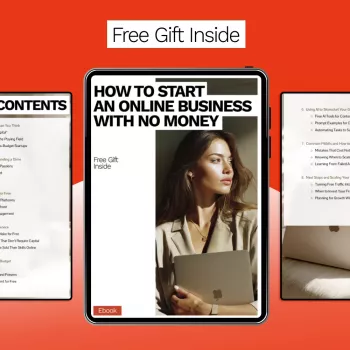
- How to Start an Online Business with No Money | Step-by-Step Beginner eBook Guide | Learn How to Start an Online Business with No Money Using Free Tools & AI (USD 21.99)
- The Ultimate Business Growth Hack Checklist: Scale Smarter, Not Harder | Digital Download for Entrepreneurs & Small Business Owners | Business Growth Hacks (USD 4.99)
FAQ
What is the easiest online business to start with no money?
A service business is usually the easiest because you can sell your time and skills without buying inventory or software. Pick one clear deliverable (like an audit, editing package, or weekly admin support) and send 20 personalized messages to potential customers to validate interest quickly.
Can AI run an online business by itself?
AI can speed up drafts, ideas, and simple automations, but it can’t replace human strategy, judgment, and accountability. You still need to verify accuracy, deliver quality, protect customer trust, and keep marketing ethical and realistic.
How long does it take to make the first sale online with no budget?
It can take a few days to a few weeks, depending on how clear your offer is and how consistently you do outreach. Faster results usually come from daily messaging, quick feedback from real prospects, and refining the offer instead of endlessly building.















Leave a comment